

1. Attend all of your lectures and workshops!
Many students seem to think that, because lectures are often recorded and available online, there is no need to attend lectures in person. I believe that this is completely the wrong outlook to have. I remember being told by a lecturer that a study had shown that students who attend all of their lectures in person often perform much better than those who don’t. This really stuck in my mind and gave me an incentive to attend all my lectures.
Also, if you do not attend your lectures in the first place then you will have to spend time catching up on them. When I caught up on them at home I found myself being more distracted, pausing the recording, being on my phone and so on. It therefore took up more of my time than if I just went to the lecture in the first place. The less time you spend catching up on your lectures, the more time you will have to study for those better grades.
Because I also had more distractions if I was catching up on a lecture, I would be less engaged. This meant that I sometimes didn’t fully understand the concepts/the content of the lecture because I wasn’t fully concentrating – you cannot afford to not have a crystal clear understanding if you are aiming for a 1st. I attended all my Family Law lectures and I didn’t, in comparison, attend all of my medical ethics lectures because I didn’t enjoy it as much – guess which module I excelled in?!?!

2. Doing the reading is vital!
I cannot reiterate how important the reading is. You are not going to receive all the information needed to get a 1st just by going to the lectures, hence why reading is such a big part of any degree. Your university will supply you with reading lists and it is vital that you complete them. Obviously you will be studying multiple subjects and will have to manage your time accordingly. What I found to be extremely helpful was to plan in advance. Do not just take the reading list as a whole because, quite simply, you will be put off by it. Instead, make a list of everything you need to read for that lecture in that week and then break up the reading and spread it over a set amount of days. This will make it much more manageable. Do not attempt to read everything in one go, this will not be effective as you will not take everything in. You actually need to be analysing as you’re reading I.e. why is this important? What are the wider implications?
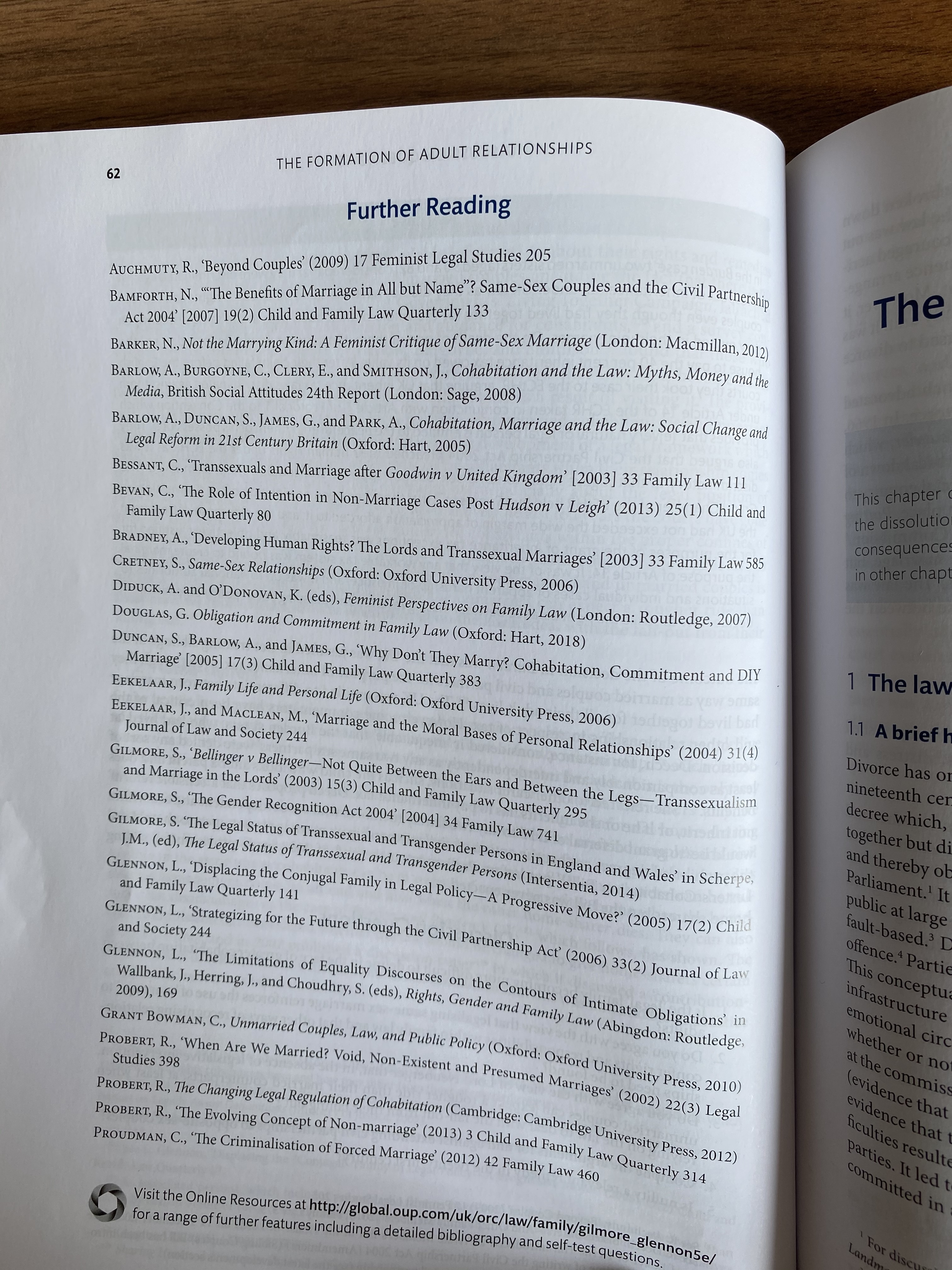
Once you have done all of the required reading, the best thing to do is to go a little bit further. Independent research is the best way to further your knowledge and areas for discussion/analysis of the law. A good place to look for this will be within your text books, for example see below. I found that because I really enjoyed Family Law I didn’t find the reading to be a chore and was also looking to expand my knowledge. By doing my own research, I found that I had more discussions for essays and a better understanding of how the law worked in practice. I was therefore able to demonstrate the required knowledge and application of the law for a first class mark.
3. Stay organised and use your time effectively
It is vital that you stay organised and up to date. If you don’t then you’ll be constantly trying to play catch up and won’t have time for the more in-depth study needed to achieve a first, nor will you be able to accord enough time to each and every subject. I started studying, reading and preparing notes from the very outset, literally I remember revising on the first day! I always made a timetable so that I had enough time for each subject, I found that I was then less stressed because I knew that I would have time to fit everything in because I had written it down and simply knew I had enough time. Any spare time that I had I utilised for studying and constantly trying to improve – use your time wisely, efficiently and proactively in order to achieve top marks.
4. Make the effort to resolve any uncertainties you have!
This is so so so important, if not the most important! The fact of the matter is that in order to get a 1st you need to be able to apply the law so precisely and effectively, and be able to analyse the law in a coherent manner. You will not be able to do this unless you have a crystal clear understanding of the law – fact. Therefore, if you have any uncertainties then ask your lecturer to explain. If you are not sure about a concept and this concept came up in an exam, your writing will show that you are not 100% confident on it. Furthermore, even having a slight bit of uncertainty within one particular topic could be the make or break! I feel that with family law, I really cared and enjoyed it and so I made the effort to ensure that I was 100000% certain about every area of it on the syllabus. Because of this, I was so much more confident and I feel like this came across in the exam. I knew everything I was saying was correct and accurate.
5. Have effective revision notes
Once I had gathered all of my lecture and reading notes for a topic, I would spend a decent amount of time ensuring that these were set out in a coherent manner/in a document that I could use as a revision tool. You won’t be able to revise with notes that are just big chunks of text, well personally I don’t see this as effective and it’s a bit boring. What I found immensely helpful was to make a structure. For example, see a section of my notes below in relation to the Children Act. For a bit of context, these are revision notes that I used in conjunction with my closed note, problem question exam I was to sit. However, I feel like you could easily adapt this tip for essay-based or open-book exams.
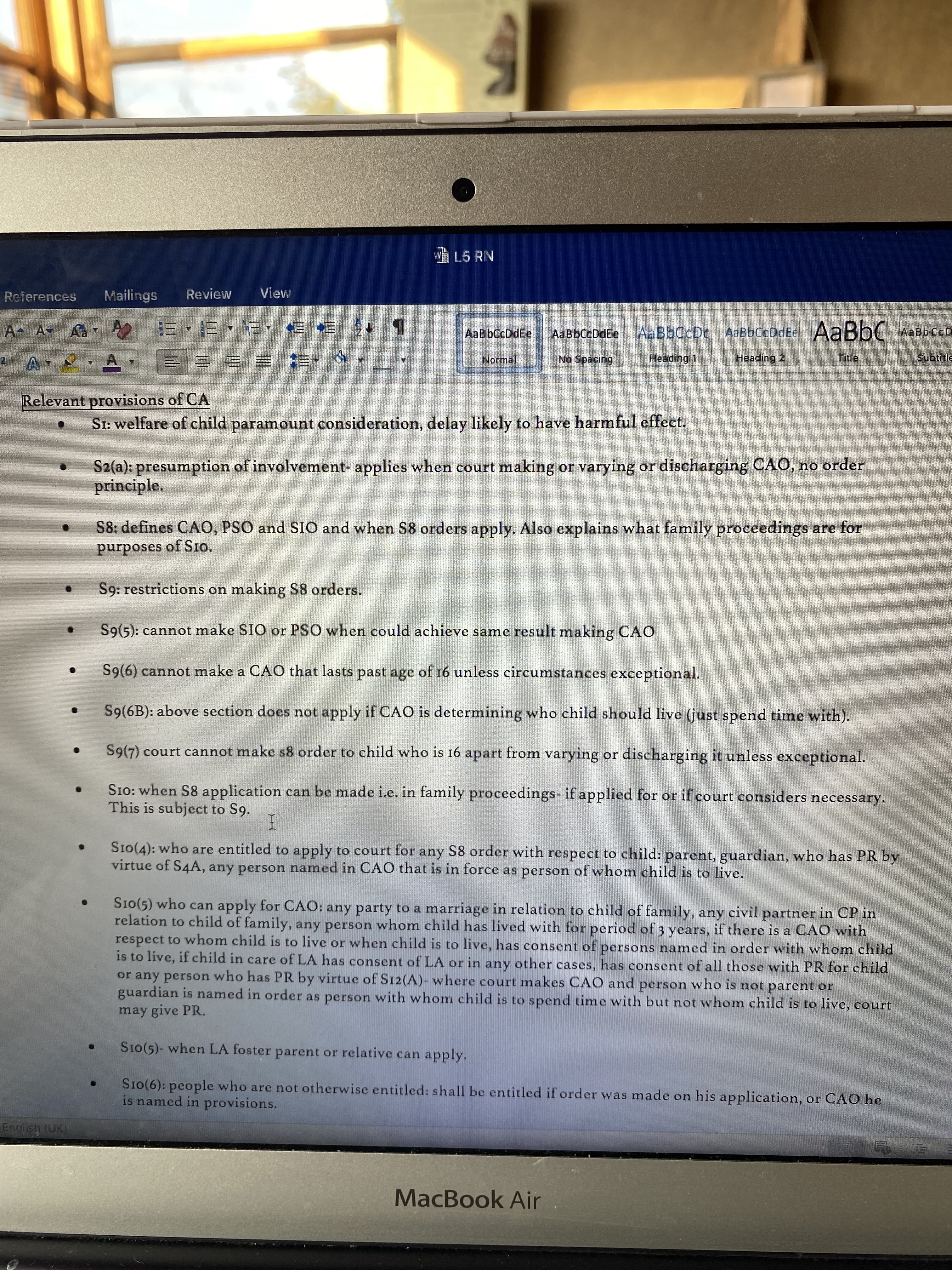


So what I would do is list all of the relevant provisions that I would need to apply in the scenario that a question came up on private law children. Yes, you are most likely to be allowed to take a statute book into the exam but you need to be able to know, without looking at your book, which provisions of the statute are relevant for what question. If you do not, you will spend so much time flicking through your book in the exam and this is not a good use of time. You need to spend as much time as possible writing and not flicking through your book.
Once I had identified all of the provisions needed for each type of problem question (you can identity this through your lectures obviously and by doing past papers to get a feel for the types of questions that are asked) I would put all of the provisions in order I.e. beginning with what I would need to start with first or some kind of structure that could be applied to most problem questions. I would literally then memorise this by going over and over it until it was stuck in my mind. Once I had a structure, I would go and expand on each principle/section of my notes. This structure I used would prompt my mind in the exam, I would recite the structure by quickly writing down my bullet points on the side of the paper and this would ensure I included all the information I needed to in order to unlock those higher marks.
With regards to case law, I found the most effective revision technique to be flashcards. Keep your notes precise and to the point so that they are fairly easy to memorise and don’t waste time memorising information that is not relevant. I find the key points to be the facts, context, judgement, reasons and implications.
6. Tabbing and Highlighting
I found that having an effective system of highlighting was also key to saving me time in exams and achieving those higher grades. You need to have a system in place that will allow you to find provisions ASAP. Therefore, the less time you are wasting trying to find a certain provision in an act, the more time you can spend writing and gaining marks.
Below is an example of what I did:


So, for example, each colour tab and highlighting would represent one area of law. For example, blue may be Competition Law, yellow Free Movement of People etc. I would make a colour code and memorise what each colour stood for. Therefore, when I opened up my exam paper and saw that the first problem question was on a particular topic, I know I would be looking for all the tabs/highlighting in relation to that particular colour. I could therefore easily find what I was looking for and didn’t have to waste valuable writing time.
I hope the above is helpful – remember, hard work WILL pay off! As long as you ensure that you know what the examiners are looking for, you utilise your feedback, ensure that you correct any uncertainties and push yourself with further independent research, then you will definitely be on the rights tracks to achieve that 1st. Good luck and happy studying!🍀🍀🍀
 legallifeofabby.law.blog